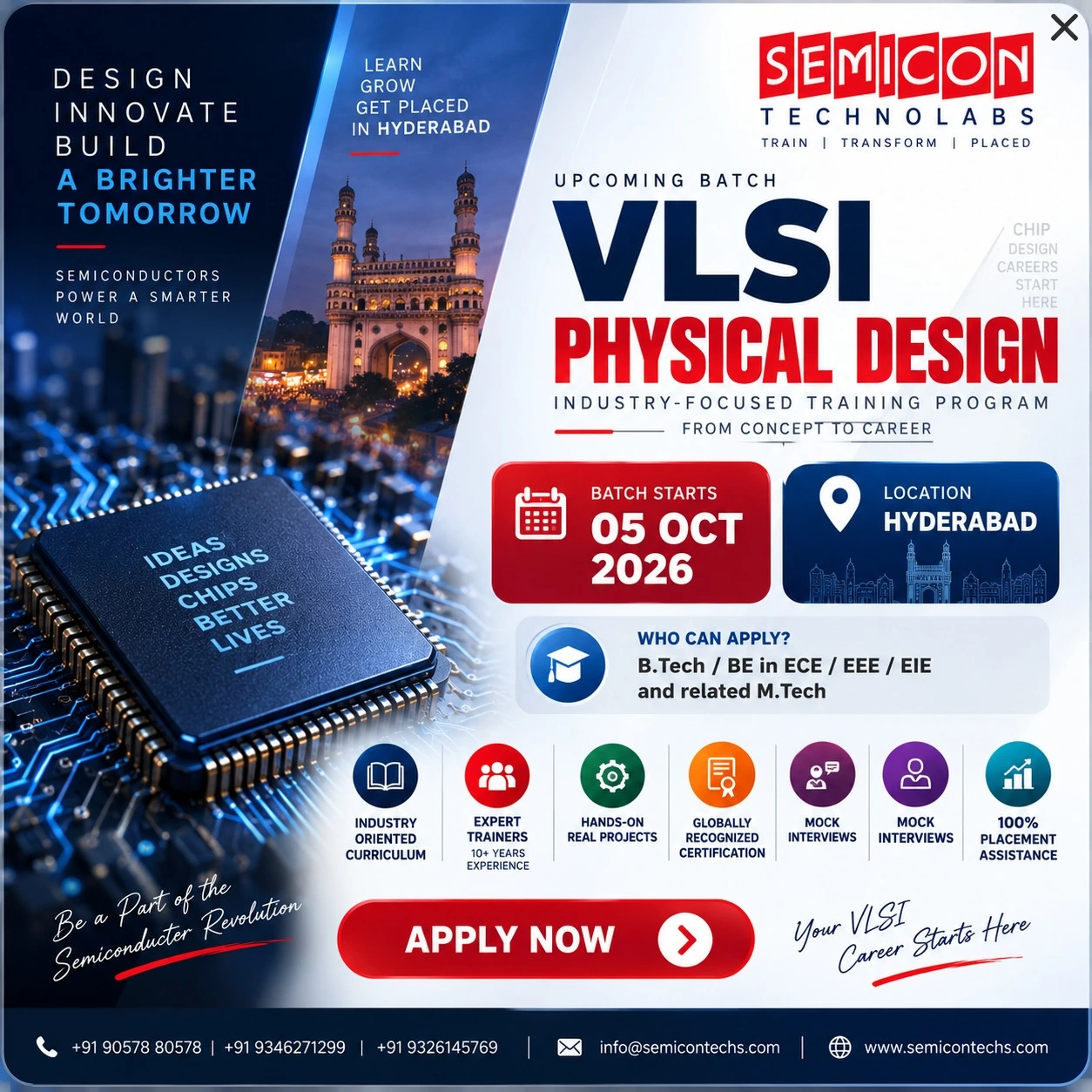
In 2025, the competition for VLSI placements in India has become more intense than ever before. With the semiconductor industry expanding rapidly, thousands of engineering graduates are now seeking specialized VLSI training to secure high-paying jobs in design, verification, and physical implementation. However, the placement landscape remains challenging, and many institutes struggle to meet student expectations. Behind every successful placement announcement lies a series of pressures, complexities, and systemic gaps that the public rarely sees.
One of the underlying issues is the mismatch between student expectations and industry standards. Many learners enter VLSI training programs believing that completing a short-term course guarantees a job in a semiconductor company. The reality is far more nuanced. VLSI engineering is highly skill-intensive, requiring strong fundamentals, extensive hands-on practice, and a deep understanding of debugging methodologies. Students who underestimate the difficulty of mastering these skills often find themselves unprepared during interviews, leading to a growing gap between job aspirations and actual readiness.
Another factor contributing to placement struggles is the uneven quality of training across institutes. While certain well-established institutes maintain strong industry networks, updated labs, and rigorous project-based coursework, many newer programs lack the depth required to produce job-ready engineers. The rapid commercialization of VLSI training has led to the emergence of institutes that prioritize enrollment numbers over quality. As a result, companies become hesitant to hire from lesser-known institutes, further intensifying competition for limited placement slots.
In addition to quality disparities, the semiconductor industry itself has become more selective. Companies now expect candidates to demonstrate practical experience in handling real project complexities, such as constraint-based optimization, power-aware design, verification closure, and timing sign-off. They also prioritize engineers who can work on multi-million-gate designs and understand advanced manufacturing constraints. Institutes that cannot provide exposure to such tasks find it difficult to place students in competitive roles. Even students with strong theoretical knowledge face challenges if they lack experience with modern EDA tools and real-world debug scenarios.
A less visible but important challenge is the growing pressure on placement teams. Institutes are expected to deliver high placement rates despite limited recruiter partnerships, varying student competence levels, and increasing expectations from both parents and learners. Placement coordinators must navigate a delicate balance—managing relationships with semiconductor companies, preparing students for stringent hiring processes, and ensuring that training standards align with industry expectations. This constant pressure has turned placement activity into a year-round responsibility rather than an end-of-program event.
Despite these obstacles, many VLSI institutes in India are adapting with renewed focus and innovation. Several training centres are now investing in advanced labs, cloud-based design environments, faculty upskilling, and integrated internship programs. Institutes are also building long-term partnerships with semiconductor companies to facilitate smoother hiring processes. A growing emphasis on project-based learning, mentorship-driven training, and real-time problem-solving is helping bridge the readiness gap. Student awareness is also improving, with more aspirants understanding the commitment required to succeed in VLSI.
As the semiconductor sector continues to expand, the landscape of VLSI placements will evolve even further. Institutes that embrace modernization, transparency, and high-quality training will emerge as leaders in the coming years. However, the hidden pressures behind placements will remain a critical aspect of the training ecosystem, shaping how institutes prepare their students for one of India’s most demanding yet rewarding career paths.
https://shorturl.fm/crxl4
https://shorturl.fm/YKBjF
https://shorturl.fm/ZFGp7
https://shorturl.fm/nmBiY
https://shorturl.fm/89kMq
https://shorturl.fm/r7wZ5
https://shorturl.fm/wVkbI
https://shorturl.fm/3jnel
https://shorturl.fm/cwJA2
https://shorturl.fm/kgLyg
https://shorturl.fm/fICFm
https://shorturl.fm/UDLfd
https://shorturl.fm/nlWh4
https://shorturl.fm/rWODY
https://shorturl.fm/jWFZ7
https://shorturl.fm/ndTe6
https://shorturl.fm/GubC3
https://shorturl.fm/5Zv1G
https://shorturl.fm/a5geU
https://shorturl.fm/W8LkK
https://shorturl.fm/wIR1A
https://shorturl.fm/dnEVf
https://shorturl.fm/42kwL
https://shorturl.fm/c9kET
https://shorturl.fm/rxEoq
https://shorturl.fm/lpXKX
https://shorturl.fm/T9xkD
https://shorturl.fm/9p0NA
https://shorturl.fm/cQOKd
https://shorturl.fm/MKdHS
https://shorturl.fm/e3L96
https://shorturl.fm/PkB0R
https://shorturl.fm/YiIks
https://shorturl.fm/xaq6p
https://shorturl.fm/zPgEB
https://shorturl.fm/6mUeb
https://shorturl.fm/W70Uk
https://shorturl.fm/behUC
https://shorturl.fm/1MBse
https://shorturl.fm/IsJ93
https://shorturl.fm/Kr6Mv
https://shorturl.fm/Ig2fF
https://shorturl.fm/yqVTZ
https://shorturl.fm/ppr1P
https://shorturl.fm/O50Dc
https://shorturl.fm/8cAK8
https://shorturl.fm/lwbTt
https://shorturl.fm/gcQB8
https://shorturl.fm/vJfGf
https://shorturl.fm/wuNZC
https://shorturl.fm/Qfnfk
https://shorturl.fm/EfrBE
https://shorturl.fm/nvmrL
https://shorturl.fm/Jlftl
https://shorturl.fm/YSZIh
https://shorturl.fm/wpGyF
https://shorturl.fm/TjQXr
https://shorturl.fm/9rtk6
https://shorturl.fm/GiJji
https://shorturl.fm/Huis1
https://shorturl.fm/EIHy3
https://shorturl.fm/UGpa6
https://shorturl.fm/YSbWF
https://shorturl.fm/GPV4h
https://shorturl.fm/Rwttv
https://shorturl.fm/gZXkb
https://shorturl.fm/eU193
https://shorturl.fm/nSxe3
https://shorturl.fm/WmJjn
https://shorturl.fm/iRqcJ
https://shorturl.fm/q6ODy
https://shorturl.fm/BnPpl
https://shorturl.fm/NHUFl
https://shorturl.fm/UCtlC
https://shorturl.fm/XIDa8
https://shorturl.fm/QMRf6
https://shorturl.fm/9MXf4
https://shorturl.fm/dkVzP
https://shorturl.fm/vRMTb
https://shorturl.fm/TOBHL
https://shorturl.fm/X0xZU
https://shorturl.fm/apdzJ
https://shorturl.fm/iQ82x
https://shorturl.fm/A7fkp
https://shorturl.fm/UxDug
https://shorturl.fm/E8uQY
https://shorturl.fm/AHGmJ
https://shorturl.fm/UawLA
https://shorturl.fm/JZzEu
https://shorturl.fm/aS1jI
https://shorturl.fm/OhKqP
https://shorturl.fm/JnI6F
https://shorturl.fm/OtKsi
https://shorturl.fm/PQFmd
https://shorturl.fm/ITEYo
https://shorturl.fm/YKiyH
https://shorturl.fm/ILQEZ
https://shorturl.fm/ewuxh
https://shorturl.fm/QYh1b
https://shorturl.fm/pjNKG
https://shorturl.fm/mJNvh
https://shorturl.fm/rfwti
https://shorturl.fm/0rYLJ
https://shorturl.fm/Fxmgi
https://shorturl.fm/PBwz3
https://shorturl.fm/KAVIa
https://shorturl.fm/Q93yc
https://shorturl.fm/PRzs2
https://shorturl.fm/p9vVW
https://shorturl.fm/1hw3O
https://shorturl.fm/B50x8
https://shorturl.fm/rTtRi
https://shorturl.fm/a9zsG
https://shorturl.fm/3jMjk
https://shorturl.fm/4omQa
https://shorturl.fm/uV332
https://shorturl.fm/HkiwD
https://shorturl.fm/rw6zB
https://shorturl.fm/bpXB6
https://shorturl.fm/9FLNs
https://shorturl.fm/fNn9O
https://shorturl.fm/ExB27
https://shorturl.fm/jZlR5
https://shorturl.fm/eTWQp
https://shorturl.fm/0qHGC
https://shorturl.fm/emAaZ
Hi https://is.gd/9PLRLO
Join our affiliate program today and start earning up to 30% commission—sign up now!
Unlock exclusive rewards with every referral—apply to our affiliate program now!
Join our affiliate family and watch your profits soar—sign up today!